
GST : 27AAFFV7667M1ZA

call images

Call us

08045801431

How to Choose the Best Ceiling Dehumidifier for Your Business

Excess moisture can quietly disrupt a business. It may fog cold-room surfaces, dampen cartons, corrode equipment, and leave a persistent musty smell. The U.S. Environmental Protection Agency advises keeping indoor relative humidity below 60%, ideally between 30% and 50%, to help limit mold growth. That is a useful target, not a substitute for assessing each space. A restaurant kitchen, archive, warehouse, and indoor pool face very different moisture loads.

Choosing a Ceiling Dehumidifier means looking beyond room size. The ASHRAE Handbook—HVAC Applications provides professional guidance on ventilation, moisture control, and HVAC system design. Use a qualified assessment to estimate moisture sources, operating hours, temperature, air movement, and the required removal capacity. Check the unit’s performance conditions, too: rated capacity may not match real-world output in a cooler or more humid room. Details matter.

Installation deserves equal attention. Confirm that the ceiling structure can support the equipment, and plan condensate drainage, electrical access, filter servicing, and safe maintenance clearance. Consider controls, noise, energy use, and how evenly dry air will reach occupied areas. A unit that fits neatly above the ceiling may still be difficult to service. That happens.

There is no universal best model. Compare documented performance, warranty terms, service availability, and installation requirements, then verify the choice against site conditions. Even careful calculations can miss a door opened all day or a production line that releases unexpected moisture. Recheck humidity after installation. A little humility helps.
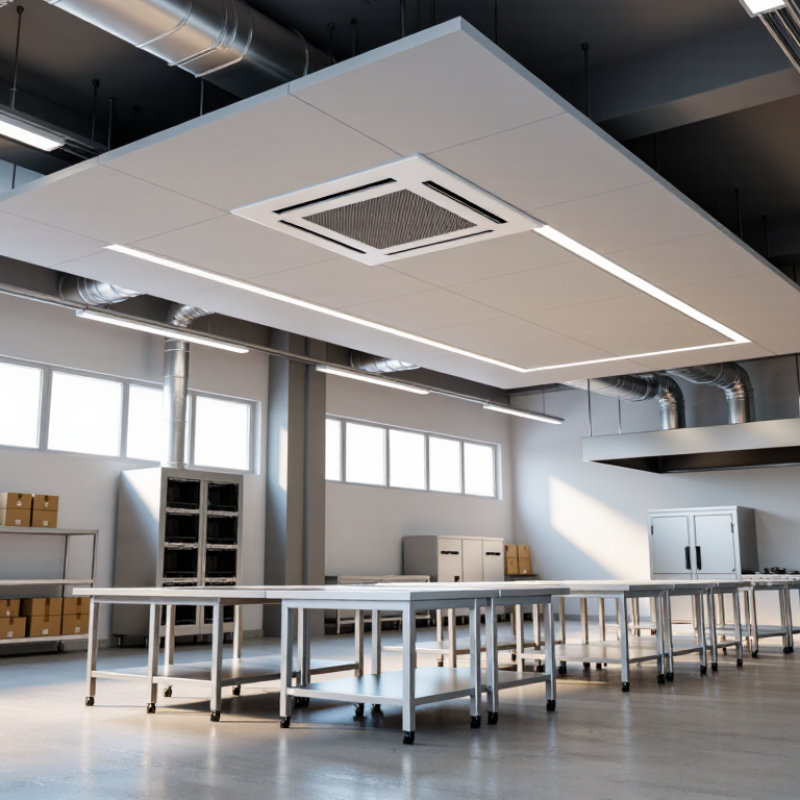
How to Choose the Best Ceiling Dehumidifier for Your Business

Understand How Ceiling Dehumidifiers Work in Commercial Spaces

A ceiling dehumidifier manages moisture by drawing room air through a filter and across a cold coil. When the coil surface falls below the air’s dew point, water condenses and flows into a drain. The drier air may be warmed slightly before returning to the room. Some commercial systems use desiccant material instead, so check the equipment design before comparing performance claims. The process is quiet, but not silent.

Mounted overhead, the unit can free floor space and distribute treated air across a shop, office, or storage area. Airflow still matters. Shelving, partitions, and tall equipment can create damp pockets, especially near exterior walls. A humidity sensor placed beside a supply outlet may give misleading readings; monitor conditions where people or moisture-sensitive stock actually are. In a busy kitchen or laundry area, door openings and ventilation add moisture that the unit must handle. Sizing by floor area alone can miss that load. Check the condensate route, filter access, and ceiling structure during planning. These details are easy to overlook, and real rooms rarely behave exactly like a neat equipment diagram.

How to Choose a Ceiling Dehumidifier for a Commercial Space

Understand how indoor relative humidity relates to the amount of moisture the air contains.

At a constant 24°C (75°F) and standard atmospheric pressure, warmer or more humid air conditions can mean more water must be removed to reach a target humidity. These humidity-ratio values are calculated psychrometric estimates, not equipment performance ratings. For sizing, consider room volume, air leakage, moisture sources, operating conditions, and the dehumidifier’s rated capacity.

Assess Your Business’s Humidity Sources and Environmental Conditions

Before choosing a ceiling dehumidifier, identify where moisture enters and when it peaks. Commercial kitchens generate steam; laundry areas release moisture during drying; loading doors admit humid outdoor air. Leaks, wet cleaning, and crowded shifts can add hidden loads. Watch a full shift. The U.S. Environmental Protection Agency advises keeping indoor relative humidity below 60%, ideally between 30% and 50%. Treat this as a useful control range, not a substitute for assessing process needs.

ASHRAE’s HVAC Applications guidance identifies occupants, ventilation, and process activity as separate contributors to moisture load. Record temperature and relative humidity near wet equipment, doors, and occupied work areas. Check outdoor dew point, too. A cool room with frequent door openings behaves differently from a warm, sealed production space. High ceilings and blocked airflow can also leave readings uneven. One day is not enough.

Use calibrated data loggers at breathing height and near the ceiling for several busy days. Compare readings during production, cleaning, and quiet periods; note condensation on pipes or windows. These details help estimate actual moisture removal needs and choose a location with clear airflow and drainage. The first estimate may still be wrong. Recheck after installation, because seasons and operating schedules change the load.

Sources: U.S. EPA, A Brief Guide to Mold, Moisture and Your Home; ASHRAE Handbook—HVAC Applications.

How to Choose the Best Ceiling Dehumidifier for Your Business - Assess Your Business’s Humidity Sources and Environmental Conditions

Assessment dimension What to check Typical examples Why it matters for selection
Moisture from people and operations Occupancy, operating hours, process schedules, and activities that release water vapor. Busy kitchens, fitness areas, laundries, indoor pools, and production spaces with wet processes. Peak operating conditions can create a greater moisture load than an empty-room estimate suggests. Size equipment for realistic peak use.
Outdoor air and building leakage Ventilation rates, frequently opened doors, loading bays, and air leakage through the building envelope. A humid climate, a high-traffic entrance, or outdoor air supplied for ventilation. Moist outdoor air adds latent load. Dehumidifier capacity should be coordinated with ventilation and HVAC design rather than considered in isolation.
Water and wet materials Leaks, floor washing, wet products, uncovered water, drying areas, and drainage performance. Washdown zones, damp stock, fresh concrete, or water entering through a roof or foundation. Repair leaks and address persistent water sources first. Dehumidification is not a substitute for correcting water intrusion or inadequate drainage.
Room size and ceiling layout Floor area, ceiling height, room volume, partitions, and obstructions above or below the ceiling. A large open warehouse versus several enclosed rooms with separate air zones. Volume helps describe the space, but it does not determine capacity by itself. Air distribution and room separation affect placement and the number of units required.
Temperature and humidity readings Log temperature and relative humidity at multiple locations and times, including busy periods and seasonal changes. Persistent high readings, large room-to-room differences, or humidity increases during production. A monitoring record reveals operating patterns and supports a more reliable load assessment than a single spot measurement.
Required indoor conditions Product, process, comfort, and building requirements; identify the target range with the relevant specialist where needed. Storage specifications, condensation prevention, or comfort needs in occupied areas. There is no single humidity target suitable for every business. Set a target based on the use of the space and avoid unnecessary over-drying.
Condensation and surface temperatures Inspect cold pipes, ducts, windows, roof surfaces, and exterior walls for condensation or dampness. Water droplets on cold surfaces or recurring damp patches near thermal bridges. Condensation occurs when a surface is below the air’s dew point. Insulation, air sealing, and temperature control may be needed alongside dehumidification.
Air distribution and obstructions Check supply and return airflow, shelving height, machinery, partitions, and likely stagnant zones. High storage racks, suspended ceilings, or equipment that blocks air movement. A ceiling-mounted unit needs a clear air path and suitable circulation to treat the intended area evenly.
Installation and condensate removal Available ceiling structure, service access, electrical supply, drainage route, and condensate-pump requirements. Limited plenum clearance, long drain runs, or areas where routine access is restricted. Confirm mounting loads, clearances, drainage, and maintenance access before choosing a ceiling unit. Installation should follow applicable codes and manufacturer instructions.
Capacity and controls Compare moisture-removal capacity at the expected operating temperature and humidity, airflow, control options, and duty requirements. Demand that varies by season, production shift, or occupancy. Use rated performance under conditions close to the site conditions. A qualified load calculation is preferable to selecting by floor area alone.

Practical assessment: record humidity and temperature over representative operating periods, identify and correct water sources, then use the findings to determine the required capacity, airflow, placement, and drainage plan.

Calculate the Required Moisture Removal Capacity

To calculate the moisture removal capacity for a ceiling dehumidifier, start with the room’s floor area and ceiling height. A 12-by-10-metre workshop with a 4-metre ceiling holds 480 cubic metres of air. But room volume alone does not determine capacity. Record temperature and relative humidity during busy periods, then note moisture sources such as washing, wet products, open doors, or steam-producing equipment. Measure more than once; a quiet morning can hide a damp afternoon.

Tips: Keep a simple log for several working days. Note humidity, operating hours, and any collected water. Keep a log.

Use those observations to estimate the daily moisture load, then compare it with dehumidifier ratings at temperatures and humidity levels close to your actual conditions. A rating measured in warm, humid air may overstate performance in a cool storage room. Include moisture entering through ventilation or frequent door openings, and allow for peak production periods. If the figures vary widely, choose capacity based on the dampest normal operating conditions, not one unusually dry day. This estimate will still be imperfect; verify it after installation by tracking humidity and drainage. If humidity remains high, check airflow, controls, and moisture sources before assuming the unit is too small.

Compare Installation Needs, Controls, and Energy Efficiency

A ceiling dehumidifier can keep valuable floor space clear, but installation details matter. Check the ceiling structure, unit weight, service clearance, and route for condensate drainage before comparing models. In a low-ceiling stockroom, even a suitable unit may obstruct lights or make maintenance awkward. Measure the actual access path, not just the ceiling opening. Small details matter.

Compare controls that match how the business operates. A reliable humidistat, clear setpoint display, and automatic restart can help maintain steady conditions. For spaces with changing occupancy, adjustable schedules or remote alerts may be useful. Ask where the humidity sensor sits; a sensor near a doorway may read differently from one near stored goods. More features are not always better. Staff need controls they can understand and use correctly.

Energy efficiency should be judged alongside room size, moisture load, and operating hours. Look for published power consumption and capacity under stated conditions, then estimate likely runtime for your space. A high-efficiency rating alone does not guarantee low bills if the unit runs constantly. That comparison can be imperfect: real humidity and door traffic vary day to day. Review drainage, filter access, and maintenance needs too, since neglected equipment may perform poorly over time.

Evaluate Maintenance Requirements and Total Operating Costs

When comparing ceiling dehumidifiers, look beyond the purchase price. The U.S. Energy Information Administration’s 2018 Commercial Buildings Energy Consumption Survey found that space cooling accounted for about 10% of commercial building energy use. A dehumidifier adds another electrical load, so compare its rated power with expected run hours and your local electricity rate. Ask for performance data at your actual indoor temperature and humidity; published capacity can change significantly with conditions.

Maintenance affects cost, too. Check whether filters can be removed safely from ceiling level, how often they need cleaning, and whether drain pans and condensate lines are easy to inspect. A clogged drain can mean water damage, not just a service call. Include labor, replacement filters, pump parts, and downtime in a five-year estimate. DOE guidance for building operators also emphasizes routine HVAC inspection and maintenance to help preserve system performance. Small details matter.

I would compare annual energy, scheduled service, and likely repairs in one spreadsheet. It is useful, but not perfect: labor rates and actual moisture loads are easy to underestimate. Request a maintenance schedule and written parts costs before buying. Then check whether the unit can be serviced without disrupting staff or closing a work area. These costs add up.

Back to top
