How to Choose the Best Pickleball Training Machine?
Choosing a Pickleball Training Machine is less about buying the fastest model and more about matching its features to your practice. A compact backyard court may need a lightweight machine with a small footprint. A coach running group drills may value larger ball capacity and adjustable feed settings. Small details matter.
Before comparing models, consider what you actually want to improve. Consistent groundstrokes call for repeatable feeds, while reaction drills benefit from varied placement and pace. Check the machine’s speed range, oscillation pattern, ball capacity, and setup time. Then compare those specifications with the drills you plan to practice. A long battery life sounds useful, but it may not matter if your sessions rarely last an hour. That part is easy to overlook.
Court space and portability deserve a close look, too. Measure the area where the machine will sit, and consider how far you must carry it from storage. If possible, watch a demonstration or test a unit before buying. Product descriptions do not always show how quickly settings can be changed between drills. A little uncertainty is normal. Even a well-reviewed machine may not suit your playing style.
This guide will explain how to weigh performance, ease of use, durability, and price without paying for features you may never use. It will also highlight practical questions about maintenance and support. The best choice is the one that fits your court, routine, and goals—not simply the one with the longest feature list.
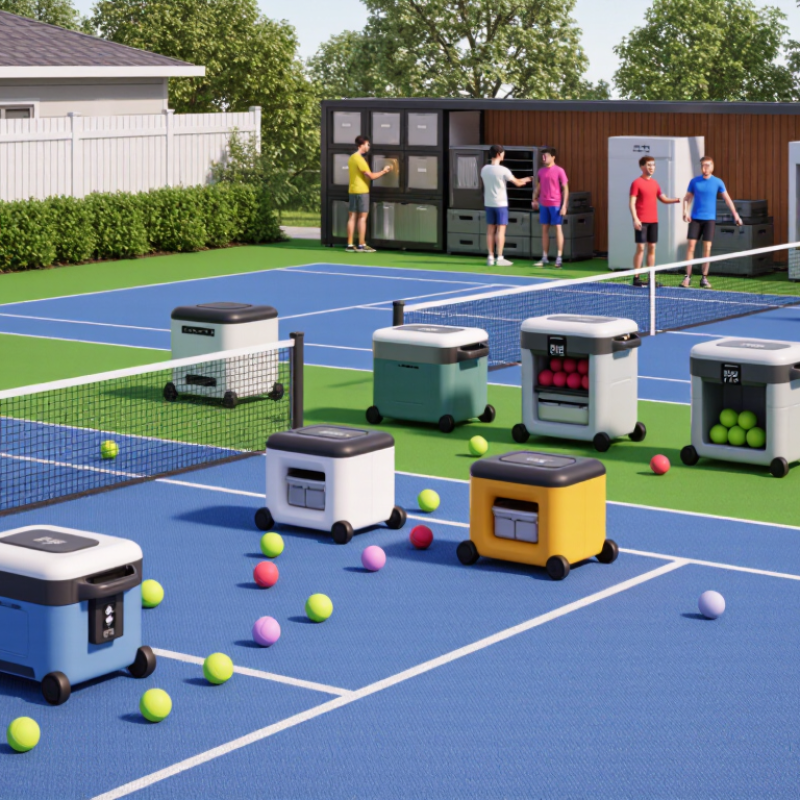
Define Training Goals Around the Standard 20-by-44-Foot Pickleball Court
Before choosing a pickleball training machine, define the shots and court zones you want to practice. USA Pickleball’s official court dimensions are 20 by 44 feet for both singles and doubles. The non-volley zone extends seven feet from the net on each side. These measurements give you practical targets: baseline depth, cross-court angles, and short balls near the kitchen line. Small targets matter.
Match the machine’s placement and feed settings to your available space. A full-size court also needs safe room beyond its boundary lines, so measure the surrounding area, not just the painted rectangle. Check whether the machine can send balls at varied speeds and trajectories. Repeating deep serves is useful, but it will not prepare you for every soft dink or sudden volley. SFIA’s 2024 Topline Participation Report estimated that 13.6 million Americans played pickleball in 2023, highlighting the sport’s expanding range of players and practice needs. A beginner may want steady feeds to build contact; an experienced player may need changing locations and pace. I would not assume more settings automatically mean better training. Pick a machine that supports clear drills, then track whether your returns land deeper or closer to your chosen target. Some sessions will still feel awkward. That can reveal what to adjust.
Match Feed Rate, Ball Capacity, and Speed Range to Player Skill
A useful pickleball training machine should match the drill, not the most impressive specification. Feed rate controls recovery time: beginners often benefit from one ball every four to six seconds, while practiced players may prefer two to three seconds for continuous footwork. Treat these as starting points, not standards; timing and ball condition change the real difficulty. Too fast? Technique slips.
Ball capacity determines how often practice pauses. Around 50 to 80 balls can work for short drill blocks, while 100 or more reduces interruptions during longer sessions. A full hopper adds weight, though, and does not improve training by itself. The SFIA 2024 Topline Participation Report estimated 13.6 million U.S. pickleball players in 2023, up 51.8% from 2022. That growth makes shared-use planning sensible: clubs may value capacity and consistent feeding, while home players may prioritize easy loading and storage.
Choose a speed range suited to the shots you actually practice. Lower settings help with controlled dinks and beginner drives; higher settings challenge reaction and depth control. Check whether adjustments are gradual, and test feeds from different court positions when possible. Numbers can mislead. Displayed speed may not reflect the actual challenge with worn balls, wind, or different spin. I would prioritize reliable low-speed control before chasing a machine’s maximum speed.
How to Choose the Best Pickleball Training Machine? — Match Feed Rate, Ball Capacity, and Speed Range to Player Skill | Player Skill | Typical Practice Goal | Suggested Feed Interval | Approx. Feed Rate | Useful Ball Capacity | Useful Machine Speed Range | Selection Tip |
| Beginner | Build consistent contact, basic footwork, and confidence returning predictable shots. | 6–10 seconds per ball | About 6–10 balls per minute | 50–100 balls | About 10–35 mph, with reliable low-speed settings | Prioritize simple controls, repeatable placement, and a slow feed. A smaller hopper is often enough for focused drills. |
| Intermediate | Practise movement, shot placement, and transitions between different court positions. | 3–6 seconds per ball | About 10–20 balls per minute | 100–150 balls | About 10–45 mph, with adjustable speed and trajectory | Look for adjustable feed timing and the ability to vary direction or launch angle so drills are less predictable. |
| Advanced | Train reaction speed, fast hands, deep returns, and demanding multi-shot patterns. | 1.5–3 seconds per ball | About 20–40 balls per minute | 150–200+ balls | About 10–60 mph, if the machine supports the intended drill | Prioritize a fast, consistent feed, broad speed adjustment, and programmable or varied shot placement. Confirm that the machine can sustain the desired pace. |
How to use these figures: The feed rates are approximate conversions from the listed intervals. Capacity and speed ranges are practical selection targets, not universal standards; available settings and actual performance vary by machine, ball type, and conditions. Choose a machine with adjustable settings so practice can progress with the player.
Compare Spin and Trajectory Using USA Pickleball Ball Specifications
When choosing a pickleball training machine, test it with balls that meet USA Pickleball specifications. Approved balls fall within a diameter range of 2.87 to 2.97 inches and a weight range of 0.78 to 0.935 ounces. Those small differences can affect how a ball feeds, spins, and travels. A machine that launches one ball cleanly may behave differently with another. Keep the ball type consistent during comparisons.
Watch both spin and trajectory. Set the machine to a moderate speed, then track whether the ball clears the net and lands near your chosen target. Add topspin and observe the bounce; try sidespin and note any curve. Repeat each setting several times. Small variations matter. A phone video can help reveal changes that are hard to judge in real time. Still, ball specifications do not guarantee identical flight: surface wear, temperature, and feed alignment can influence results. I would not trust one impressive shot. Check the pattern across a full basket, and record settings before making a decision.
How to Choose the Best Pickleball Training Machine? — Compare Spin and Trajectory Using USA Pickleball Ball Specifications
Bars show each specification’s allowed range as a percentage of its midpoint: diameter 2.87–2.97 in, weight 0.78–0.935 oz, and rebound 30–34 in. These standards help you use consistent balls when comparing machines. They do not specify machine spin rates or shot trajectories, so assess those separately using the same balls and repeatable launch settings.
Assess Portability, Power Options, and Setup for Solo Practice
A pickleball training machine should fit the way you actually practice, not just look powerful on paper. Check its weight, handle, and wheel size before buying. If you carry it from a car across a court, a bulky unit can quickly become frustrating. For solo sessions, consider whether one person can load, move, and position it without help. Small details matter: a stable base, clear controls, and a hopper you can refill between drills.
Tips: Test the setup steps at home. Bring a few balls, then see how quickly you can aim, adjust the feed rate, and start a drill. Keep the machine clear of players and obstacles.
Compare power options with your practice routine. A rechargeable battery offers freedom from nearby outlets, but check the expected run time and charging period. Plug-in power may suit a fixed court, though the cord can limit placement. Feed speed, interval, and launch angle should be easy to change while you practice. A complicated menu is not useful if you spend more time adjusting it than hitting. I’ve found that advertised capacity can feel different once balls are loaded, so leave room for a little trial and error. A machine that is simple to transport and set up may get used more often than one with extra features.
Verify Safety Features, Warranty Terms, and Service Support Before Buying
A pickleball training machine should stop reliably before it impresses you with its speed. The SFIA 2025 Topline Participation Report estimated 19.8 million U.S. players in 2024, a 45.8% increase from the previous year. More players can mean more frequent use, so inspect the ball-feed opening, frame stability, wheels, and power cord. Check that the emergency stop is easy to reach while standing in the playing area. Small details matter. Ask how to clear a jam safely, and test the stop function before each session.
Read the warranty before comparing prices. Confirm its length, what parts and labor it covers, and whether shipping costs fall to you. Look for exclusions involving normal wear, outdoor storage, or frequent commercial use. Ask how claims are filed and what proof of purchase is required. Test it yourself. A vague promise of “full support” is not a service plan; request written terms and a realistic repair timeline.
Support matters after delivery, too. Ask whether troubleshooting help is available by phone or email, and whether replacement parts can be ordered individually. Request a user manual that explains setup, maintenance, and safe operation. The SFIA’s 2024 report recorded 13.6 million U.S. players in 2023, up 51.8% from 2022, underscoring how quickly demand has grown. That does not guarantee fast service. I would still ask who handles a repair, how long parts typically take, and what happens if the machine cannot be fixed. Ask again.



 Send Inquiry

