
Choosing a Skin Tone Analyzer in 2026 takes more than comparing screens and price tags. The right tool should produce repeatable readings under realistic lighting, explain its measurement method, and work across a broad range of skin tones. Anthropologist Nina Jablonski’s research offers an important reminder: human skin color varies continuously, rather than fitting neatly into a few categories. That matters. A device that compresses subtle differences into one label may mislead product selection, shade matching, or progress tracking.
Look closely at how an analyzer captures and reports color. Check its calibration process, light source, measurement area, and consistency across repeated scans. Ask whether results change when a hand moves slightly or the room’s lighting shifts. Small details count. A clear display is useful, but transparent methods and documented testing matter more. Claims of “AI accuracy” deserve scrutiny unless the company explains how the system was evaluated and which skin tones were represented.
This guide compares analyzers by intended use, measurement reliability, usability, and support—not by marketing language alone. A salon, cosmetics lab, and skincare clinic may need different features. No device is perfect. Even a well-tested analyzer can be affected by lighting, surface products, or application technique. Use readings as informed guidance, not unquestionable fact, and verify that the model suits your setting before investing.
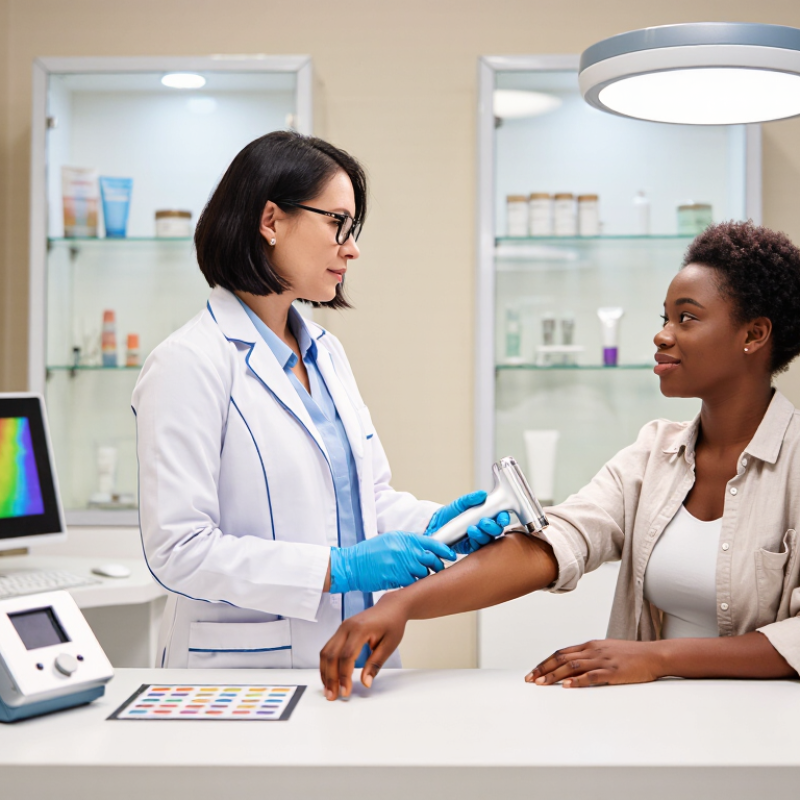
When choosing a skin tone analyzer, decide what you need it to measure. Fitzpatrick’s six phototypes describe how skin tends to respond to ultraviolet exposure, including burning and tanning. They do not simply rank skin from light to dark. That matters. A person with a medium complexion may burn easily, while someone with a similar visible tone may tan readily. The categories rely partly on personal history, so they cannot be read from a photograph alone.
Look for a tool that clearly separates visible color estimates from UV-response classification. Check whether it explains its lighting requirements, measurement limits, and intended use. A useful test is to compare readings under consistent indoor light, then see whether small changes in position alter the result. Not a color scale. If the analyzer asks about sunburns or tanning, treat those answers as part of the assessment, not as a diagnosis.
I still find the distinction easy to blur: a neat number can feel more certain than the evidence allows. Use the result as one data point, and seek qualified advice for persistent skin changes or personal medical concerns.

Compare Objective Sensors Using CIELAB’s 3 Coordinates: L*, a*, and b*
A useful skin tone analyzer should report more than a broad shade label. Look for readings based on CIELAB, which describes color through three coordinates. L* indicates lightness, from black toward white. The a* axis tracks green-to-red, while b* tracks blue-to-yellow. Together, these values can help distinguish changes that a single “warm” or “cool” label may miss. Check whether the device explains its measurement area and keeps results consistent across repeated scans. A reading can shift if the sensor moves, skin is damp, or lighting conditions change.
Tips: Measure clean, dry skin in the same spot each time. Take several readings, then compare their range—not just one number. Ask how often the sensor needs calibration.
Numbers need context. Skin varies across the face and body, and temporary redness or recent sun exposure can affect a reading. A capable analyzer should make these limits clear, rather than imply that three coordinates capture every nuance. Compare devices by repeatability, calibration guidance, and whether they display L*, a*, and b* separately. If two scans differ noticeably, pause and check placement before trusting the result. Even careful measurements are not perfect; that uncertainty deserves attention.
A useful skin tone analyzer should report ITA° transparently, not just assign a shade label. ITA° is calculated from CIELAB L* and b* values; the measurement setup matters. Del Bino and Berner’s 2013 review in Pigment Cell & Melanoma Research describes published ITA° bands: above 55° is very light, while below −30° is dark. The intermediate bands run from light to brown. These are classification ranges, not diagnoses.
Check whether the analyzer reproduces those endpoints using controlled, repeatable measurements. CIE 15:2018, Colorimetry, provides guidance for consistent color measurement, including calibrated instruments and defined conditions. Compare results from the same skin site, lighting setup, and preparation. Small shifts matter. A reading near 55° or −30° may cross a band boundary after a slight change in illumination or positioning. That uncertainty deserves attention, not a confident label.
Tips: Test samples near both endpoints, then repeat each measurement. Record the device, lighting, skin site, and result. Compare the raw L* and b* values as well as ITA°. If the analyzer does not explain its measurement conditions, treat its category cautiously. I would not assume one reading tells the whole story.
When comparing skin tone analyzers, ask for ΔE00 results, not just claims of “high accuracy.” ISO/CIE 11664-6:2014 specifies the CIEDE2000 color-difference formula. A ΔE00 near 1 is often treated as a just-noticeable difference under controlled viewing conditions. It is a useful benchmark, not a universal guarantee: lighting, skin texture, and measurement location can shift results.
CIE’s technical report CIE 142:2001 discusses color-difference evaluation against visual assessments. For a practical check, measure the same area several times, then compare readings with a calibrated reference tile and consistent lighting.
A reliable analyzer should show small variation between repeated measurements and explain its measurement conditions. Ask whether its reported ΔE00 reflects device repeatability or comparison with a reference standard; those are different things.
Skin is not a flat color card. That limitation deserves attention.
Tips: Keep the sensor clean, avoid direct sunlight, and use the same cheek or forehead area each time. Record the lighting. Even careful testing can leave some uncertainty.
A skin tone analyzer is only useful when its readings are consistent. Ask how often the device is calibrated, and whether testing uses physical reference standards rather than software alone. Request the latest calibration record. Compare repeated readings on the same clean, dry area under steady lighting. Small differences matter. A device that shifts noticeably between scans may make product matching less dependable.
Check who was included in validation. Useful testing covers a broad range of skin tones, undertones, and ages, with results reported for each group. Ask whether measurements were taken across different lighting conditions and skin areas. A single average accuracy figure can hide uneven performance. If the seller cannot explain its test method, treat impressive claims cautiously. I would not assume that a large dataset guarantees fair results; how that data was collected matters too.
Privacy deserves the same scrutiny as accuracy. Find out whether scans or photos are stored, for how long, and who can access them. Ask whether data can be deleted and whether analysis happens on the device or through an online service. Read the consent details before sharing an image. The wording may feel routine, but it can be easy to overlook. I may be cautious to a fault, yet unclear retention rules would make me pause before buying.
For an immediate response, please call this
number08045801431
Price:
