
GST : 27AAFFV7667M1ZA

Call us
08045801431
Call us
08045801431

China has become a major sourcing base for Wall Mounted Battery Harness products. Its manufacturers serve residential storage, backup power, and small commercial energy systems. Yet supplier quantity does not guarantee dependable quality. Copper plating, crimp pressure, insulation thickness, connector fit, and heat resistance can change system performance.
Dr. Shirley Meng, a widely recognized battery scientist, emphasizes, “Battery safety is a system problem, not a single-component problem.” Her point applies directly here. A Wall Mounted Battery Harness carries current through a compact, heat-sensitive environment. One loose terminal may create resistance, local heating, or intermittent power loss. Small details matter.
This guide examines China’s leading manufacturers through practical purchasing criteria. It considers engineering experience, material traceability, prototype support, testing discipline, and production consistency. Buyers should request drawings, wire specifications, terminal samples, and documented test results. Look closely at bending points and locking tabs. Those are common failure areas.
Certification claims also deserve careful review. UL, IEC, RoHS, and other standards may apply differently by product design and market. A certificate alone is not enough. Factory audits, sample testing, and clear change-control procedures provide stronger evidence.
The “best” supplier may not offer the lowest quotation. That assumption needs reconsideration. A cheaper harness can increase installation time, service calls, and replacement costs. Some manufacturers communicate well during sampling but struggle during volume production. This guide recognizes that risk and compares suppliers with a balanced, evidence-based approach. It also acknowledges an uncomfortable truth: public company information is sometimes incomplete, so responsible buyers must verify every important claim.
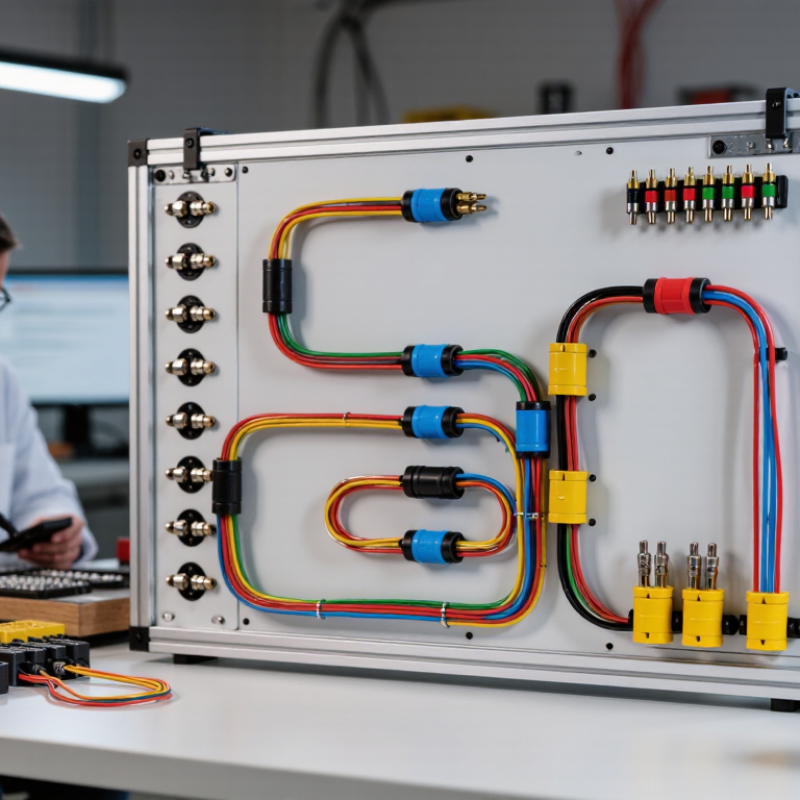
A wall-mounted battery harness is the organized wiring assembly connecting a battery module with an inverter, protection device, monitoring unit, and grounding point. It usually includes power cables, signal wires, connectors, fuses, terminals, and protective sleeves. Mounted behind or beside the battery cabinet, the harness keeps current paths short and reduces loose cables near the wall.
The design is practical, not decorative. Cable cross-section must match continuous current, peak load, temperature, and installation distance. Signal lines also need separation from high-current conductors to reduce communication errors. The International Energy Agency reported that global battery storage additions in the power sector increased by about 130% in 2023. More installations create greater demand for repeatable harness designs and traceable quality checks.
During installation inspections, technicians usually examine crimp pressure, connector locking, bend radius, insulation damage, and torque records. One loose terminal can create heat. That detail is easy to underestimate. A 2024 report from the National Renewable Energy Laboratory continues to identify lithium-ion systems as the dominant technology for many stationary storage applications, making thermal management and connection reliability especially important. I once considered cable routing a minor assembly task; that view was incomplete. The harness also affects service time, airflow, fault isolation, and future replacement work. Manufacturers should document conductor materials, voltage ratings, test procedures, and inspection results rather than relying on appearance alone.
| Data Dimension | Industry Reference or Typical Requirement | Why It Matters for Wall-Mounted Battery Systems |
|---|---|---|
| Product definition | A wall-mounted battery harness is an assembled set of power and signal cables used to connect a wall-mounted battery module with an inverter, battery-management system, protection device, display, or auxiliary equipment. | It provides organized electrical power transmission, monitoring, protection, and service connectivity inside a compact energy-storage installation. |
| Main harness circuits | Power circuits, battery-management communication circuits, temperature-sensor wiring, grounding or protective-earth wiring, and auxiliary control wiring may be included. | Separating power and low-voltage signal circuits helps reduce electromagnetic interference and simplifies installation and maintenance. |
| Conductor material | Stranded copper is commonly used because it offers high electrical conductivity and good flexibility. Aluminium may be used in selected high-current designs when the complete termination system is engineered for it. | Material selection affects resistance, voltage drop, flexibility, mass, crimping method, and terminal compatibility. |
| Cable cross-sectional area | Common harness designs may use different conductor sizes for power, grounding, and signal circuits. The required size must be calculated from continuous current, peak current, cable length, ambient temperature, installation method, and allowable voltage drop. | A larger conductor is not automatically safer; correct sizing prevents overheating while maintaining efficient battery-to-inverter operation. |
| Voltage and current rating | The harness rating must be equal to or greater than the battery system’s maximum operating voltage and continuous and peak current. The connector, terminal, fuse, and cable ratings must be considered together. | The lowest-rated component can limit the safety and performance of the complete harness assembly. |
| Insulation and sheath | PVC, cross-linked polyethylene, thermoplastic elastomer, and other insulation systems may be selected according to voltage, temperature, flexibility, flame behavior, and chemical-resistance requirements. | The insulation must withstand the enclosure environment, installation movement, heat generated by current, and potential contact with dust or moisture. |
| Connector and terminal design | Connectors should be selected for the required voltage, current, mating cycles, contact resistance, locking method, touch protection, and environmental protection level. | Secure locking and correct touch protection reduce the risk of loose connections, arcing, accidental contact, and service errors. |
| Environmental protection | The required protection level depends on the installation location. Enclosed indoor systems may need less protection than installations exposed to dust, condensation, vibration, or outdoor conditions. | Proper sealing, strain relief, and cable routing help prevent moisture ingress, abrasion, terminal damage, and premature insulation failure. |
| Battery-management communication | Communication wiring may use differential signaling or other manufacturer-defined interfaces. Pin assignment, shielding, twisted-pair arrangement, termination, and polarity must follow the approved system design. | Incorrect pinout or routing can interrupt state-of-charge, temperature, fault, and protection data exchanged between the battery and inverter. |
| Assembly quality | Important controls include verified wire length, correct stripping, calibrated crimping, terminal retention, polarity checks, continuity testing, insulation testing where applicable, and visual inspection. | Consistent assembly reduces intermittent faults, high-resistance joints, reversed polarity, and installation delays. |
| Safety and compliance documentation | A qualified supplier should provide drawings, bill of materials, wire specifications, terminal details, test records, traceability information, and applicable regulatory or customer compliance evidence. | Document control supports design verification, production consistency, installation accuracy, and after-sales troubleshooting. |
| Customization capability | Key customization variables include cable length, conductor size, connector type, branch layout, labels, protective sleeving, mounting clips, and communication pinout. | A correctly customized harness can reduce installation time and prevent field modifications that may compromise safety or warranty conditions. |
| Supplier evaluation criteria | For comparing manufacturers, review engineering capability, sample approval process, process traceability, crimp-force control, inspection equipment, production capacity, change management, and response to nonconformities. | These criteria are more meaningful than price alone when the harness is part of a high-current rechargeable energy-storage system. |
Note: Electrical ratings, cable sizes, connector selections, and applicable standards must be confirmed from the battery system design, installation conditions, and relevant local regulations. Generic values should not replace engineering verification.

 Send Inquiry


