
GST : 27AAFFV7667M1ZA

Call us
08045801431
Call us
08045801431

A Powder Sieve Machine can look simple on a factory floor: a vibrating deck, fine mesh, and a stream of powder. Yet mesh choice, feed rate, and cleaning access can shape product consistency and line efficiency. Buyers comparing China’s leading manufacturers should look beyond catalog capacity. Ask for material-specific test results, screen-change time, contact-part materials, and operating references. Details matter.
The wider equipment market offers useful context, though it is not a sieve-machine market estimate. Fortune Business Insights valued the global food-processing equipment market at USD 52.37 billion in 2023. That scale reflects sustained investment in processing lines, where reliable particle separation can support downstream steps. It does not prove that every supplier delivers equal performance. A factory visit or recorded trial can reveal what a brochure cannot.
Quality-management expert W. Edwards Deming’s principle is relevant here: “Quality comes not from inspection, but from improvement of the production process.” For sieve buyers, that means examining how manufacturers control fabrication, balance, mesh tension, and final testing—not just how they describe the finished machine. A practical comparison should include throughput under stated conditions, noise, dust containment, and maintenance support. Small details count.
There is a limitation worth admitting: published specifications rarely make different machines directly comparable. A stated capacity may depend on powder behavior, moisture, and screen configuration. The best shortlist therefore combines documented tests with a sample run using the buyer’s actual material. This introduction frames the article around China-based manufacturers, while treating claims as questions to verify—not conclusions to accept.
China Top Powder Sieve Machine Manufacturers?
What Is a Powder Sieve Machine and How Does It Work?
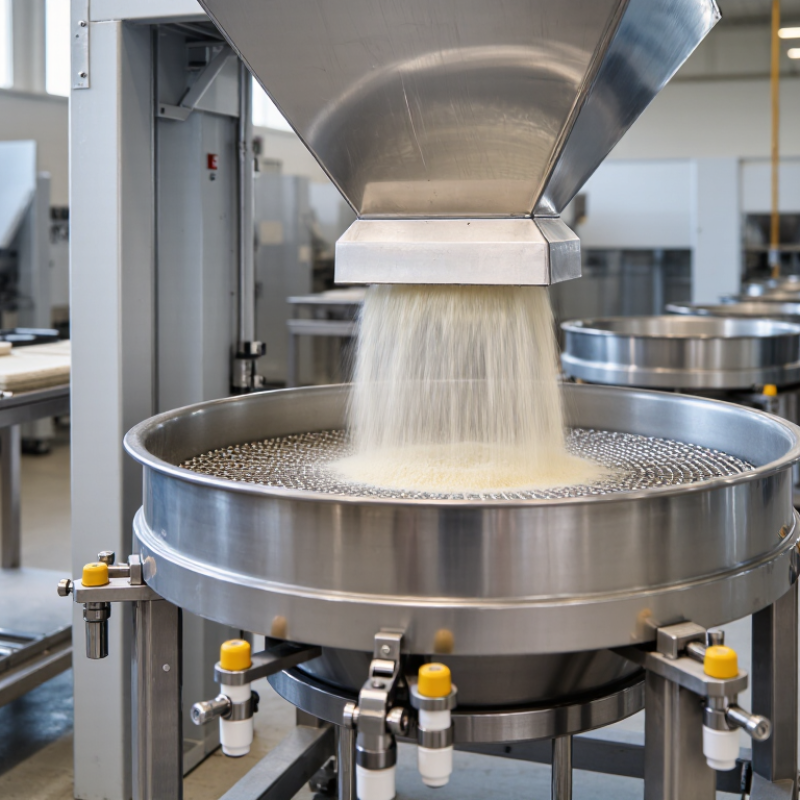
A powder sieve machine separates particles by size using a screen, vibration, or rotary motion. Powder enters the machine and spreads across a mesh deck. Smaller particles pass through its openings; oversized pieces remain above for removal or further processing. Some systems use several decks, creating multiple size fractions in one run. The operating idea is simple. The result depends on details.
Mesh selection is critical. ASTM E11-24 specifies test-sieve openings including 150 micrometres for No. 100 and 75 micrometres for No. 200 sieves. These figures help operators define a measurable separation target. In practice, moisture, static charge, particle shape, and feed rate can affect screening. A fine powder may cling to the mesh or form soft clumps, even when the nominal opening is correct.
Operators typically check mesh condition, feed consistency, and the collected fractions. A short trial with a representative sample can reveal blinding or unwanted particle carryover before full production. Keep the machine stable and use suitable dust controls for the material being handled. One limitation is easy to overlook: a sieve measures passage through an opening, not every particle’s true shape or composition. Results need context. For reliable comparison, document the mesh specification, sample size, and screening time; otherwise, repeat tests may disagree.
| Machine Type | How It Works | Typical Separation Task | Common Applications | Key Selection Considerations |
|---|---|---|---|---|
| Vibrating Sieve | A motor creates vibration that moves powder across a tensioned screen. Particles smaller than the openings pass through; larger particles remain on the screen. | Screening, grading, and removal of oversize particles from free-flowing powders. | Food ingredients, minerals, plastics, and chemical powders. | Consider screen aperture, required throughput, material flow, and whether the powder tends to blind or clog the screen. |
| Ultrasonic Vibrating Sieve | A vibrating screen is combined with high-frequency ultrasonic vibration applied to the mesh. This can help reduce mesh blockage when screening fine powders. | Fine-powder classification and screening of materials that are difficult to pass through small apertures. | Fine chemical powders, specialty minerals, and some pharmaceutical or food ingredients. | Assess powder characteristics, mesh size, cleaning requirements, and whether the material is suitable for ultrasonic screening. |
| Rotary Vibrating Sieve | The screen deck moves in a controlled circular or three-dimensional vibrating pattern, spreading material across the mesh and supporting continuous separation. | Single- or multi-stage screening by particle size, depending on the deck configuration. | Granules and powders used in food processing, chemical production, and mineral handling. | Check the number of required size fractions, screen area, feed rate, and access for screen replacement and cleaning. |
| Gyratory Sifter | A horizontal screening deck follows a gentle gyratory motion. The motion conveys material across the screen while allowing particles to separate by size. | High-capacity, accurate grading of dry bulk materials across one or more screen decks. | Large-volume applications involving food, fertilizer, minerals, and other bulk powders or granules. | Compare required capacity, available floor space, number of fractions, and the material’s flow and moisture characteristics. |
| Air-Flow Sieve | Air carries a powder sample or process stream through a screen. Fine particles pass through the mesh while larger particles are retained, with airflow assisting dispersion. | Fine-particle separation or particle-size analysis of small powder samples. | Laboratory testing and selected fine-powder applications. | Confirm the intended use, airflow control, sample quantity, and whether the material can be safely handled in an air stream. |
| Linear Vibrating Sieve | Two vibration sources or a configured drive system move the screen in a mainly straight-line path, conveying material toward the discharge end as screening takes place. | Continuous screening and conveying of dry powders or granules. | Production lines where material needs to move in a defined direction during screening. | Check the required conveying distance, feed consistency, screen inclination, and installation layout. |
How powder sieving works: A powder sieve separates particles according to whether they can pass through a selected screen aperture. Actual capacity and separation performance depend on factors such as particle-size distribution, moisture, particle shape, feed rate, screen condition, and machine settings. The machine types and applications above are general categories, not product specifications.

 Send Inquiry


