China’s scale makes supplier selection consequential. UNIDO’s International Yearbook of Industrial Statistics reports that China accounts for roughly one-third of global manufacturing value added. Grand View Research estimated the global machine tools market at USD 84.3 billion in 2023, with projected growth through 2030. These figures cover broad manufacturing and machine-tool categories, not Vertical Boring Machines alone. That distinction matters: buyers should not mistake a large market for proof of a particular supplier’s capability.
A Vertical Boring Machine must handle more than a headline swing diameter. Buyers should examine spindle condition, table runout, thermal stability, control-system options, and service response. Ask for inspection records and a test cut on a workpiece similar to yours. As quality expert W. Edwards Deming put it, “Quality comes not from inspection, but from improvement of the production process.” The quotation is relevant here: supplier discipline matters as much as the machine’s specifications. Still, one test cannot reveal everything. This guide compares Chinese suppliers by product range, engineering evidence, customization, and after-sales support. It also flags where public information is limited, because polished brochures rarely show the full picture.
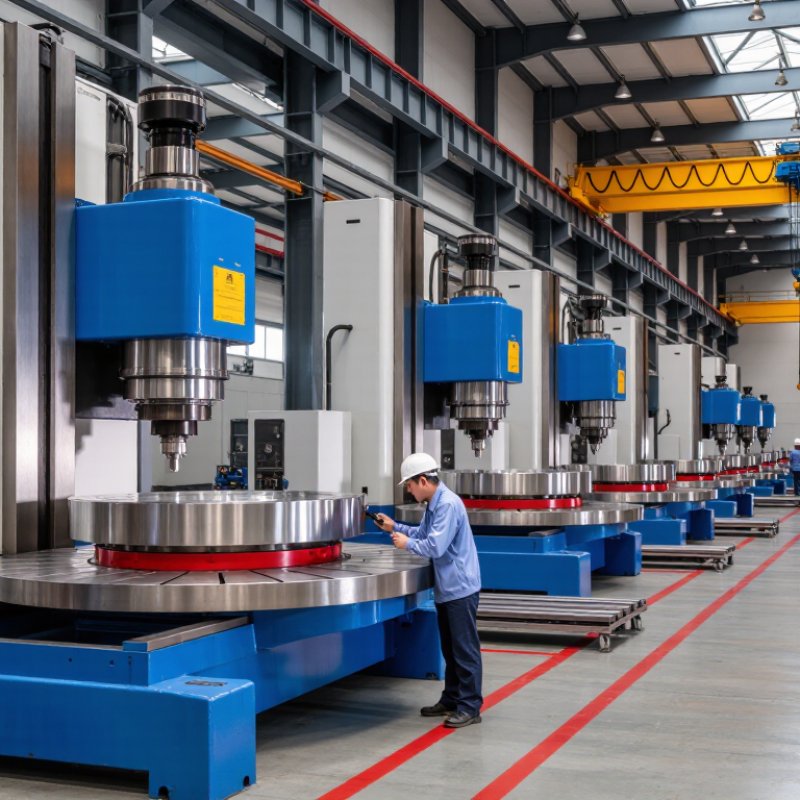
China’s vertical boring machine industry serves manufacturers that need to machine large, heavy components with accurate concentric features. Typical workpieces include pump housings, gear blanks, and turbine parts. Machines may combine vertical turning with boring, drilling, or milling operations, depending on their configuration. The local supply chain includes machine-tool builders, casting workshops, control-system integrators, and cutting-tool suppliers. Their capabilities vary.
A supplier’s catalogue gives only part of the picture. Buyers should compare table diameter, maximum workpiece height, load capacity, spindle range, and positioning accuracy against actual production needs. Ask how accuracy is measured and under what conditions. A machine cutting a test piece is more informative than a specification sheet alone. That matters.
Industry strengths often include flexible machine configurations and access to established manufacturing networks. Yet delivery schedules, technical documentation, commissioning support, and spare-parts access can differ widely. Not always. A lower purchase price may require more attention to installation, operator training, or long-term maintenance. Request references for similar materials and component sizes, then review inspection records where available. One practical limitation: public information may not reveal a supplier’s true service capacity, so direct technical discussions and factory assessments remain valuable.

Leading vertical boring machine suppliers in China design around the workpiece, not just the machine’s rated capacity. Engineers consider casting rigidity, column geometry, spindle load, and table diameter before choosing drive systems. Thick ribbed castings help resist vibration during heavy cuts. Then, assembly teams align the spindle and table, checking runout and movement across the working range. The process is exacting. Small alignment errors can leave visible tool marks on a large component.
Design choices also reflect demand for stable output. Grand View Research’s Machine Tools Market report estimated the global market at USD 84.1 billion in 2022 and projected USD 115.1 billion by 2030. This broad market forecast is not specific to vertical boring machines, but it highlights pressure for productive, repeatable equipment. Suppliers can verify geometric accuracy using methods described in ISO 230-1. In practice, temperature, foundation quality, and operator setup also affect results. Factory tests cannot reproduce every workshop condition. That limitation deserves attention.
China’s vertical boring machine suppliers include large machine-tool works, precision-focused manufacturers, and engineering-led builders. Without naming brands, these profiles show how their strengths differ. Large works often serve heavy-duty projects, with machines designed for wide tables and bulky castings. Ask about table diameter, maximum swing, and load capacity. Numbers matter.
Precision-focused suppliers tend to emphasize spindle condition, positioning accuracy, and repeatable finishing. Buyers should request inspection records and sample-part measurements, not rely on catalogue figures alone. A test cut can reveal chatter or uneven surface finish. Small details count.
Engineering-led builders may adapt machine layouts, tooling, or controls to a customer’s workpiece. This can help with unusual dimensions, but customization may extend delivery and commissioning time. Verify the proposed configuration against actual drawings. Do not assume every option is standard. A supplier profile is only a starting point; service coverage, spare-part access, and operator training also deserve close review. Specifications can look excellent on paper, yet installation conditions may change the result. That part is easy to overlook.
| Supplier Profile | Typical Machine Offering | Common Applications | Configuration Options to Check | What Buyers Should Verify |
|---|---|---|---|---|
| General-purpose CNC vertical turning supplier | CNC vertical turning lathes for turning large-diameter workpieces; capacity and axis configuration vary by model. | Flanges, discs, rings, and other parts suited to vertical workholding. | Table diameter, maximum workpiece height, table load, tool stations, and control system. | Request a machine-specific specification sheet and acceptance-test criteria for the intended material and part size. |
| Heavy-duty vertical lathe supplier | Vertical turning equipment designed for demanding workpiece loads; actual load limits depend on the machine model and setup. | Large or heavy components, including parts used in energy, mining, and heavy-equipment production. | Table load rating, cutting power, spindle torque, ram travel, and foundation requirements. | Confirm rated load, cutting conditions, installation requirements, and performance under a representative test cut. |
| Vertical boring and turning supplier | Machines combining vertical workholding with turning and, depending on configuration, boring operations. | Parts requiring large-diameter turning and internal bore machining in a vertical setup. | Boring-bar capacity, ram or cross-rail travel, tool head options, and workpiece clearance. | Check the available boring envelope and confirm that the required operations can be completed without repositioning the part. |
| Conventional vertical boring machine supplier | Manually controlled or conventionally operated vertical boring and turning machines; features differ across models. | Job-shop work, repair machining, and production tasks that do not require a fully CNC workflow. | Manual feed arrangements, table speed range, cross-rail adjustment, and available tooling. | Inspect machine condition, operating accuracy, documentation, and availability of replacement parts and service. |
| Custom-engineered vertical machine supplier | Application-specific machine configurations developed around the workpiece, process, and production requirements. | Nonstandard components, specialized production lines, and machining processes with unusual size or tooling needs. | Workholding, automation interfaces, special tooling, enclosure design, and process integration. | Agree on drawings, scope, measurable acceptance criteria, commissioning, training, and after-sales responsibilities before ordering. |
| Vertical machine supplier with automation integration | Vertical turning systems that may be supplied with workpiece handling or production-line interfaces, subject to project scope. | Repeat production where loading, unloading, or integration with adjacent equipment is required. | Robotic or gantry loading, safety systems, communication interfaces, and production-line layout. | Verify cycle-time assumptions, interface responsibilities, safety compliance, and the complete system acceptance test. |
| These are general supplier and machine categories, not a company-specific ranking. Vertical boring and turning machine specifications vary by model and configuration; confirm all capacity, accuracy, and service details directly against the proposed machine documentation. | ||||
Who Are the Top Vertical Boring Machine Suppliers in China?
Comparing Supplier Capabilities, Product Ranges, and Support
Choosing a vertical boring machine supplier takes more than comparing listed prices. Look at machine capacity, table diameter, maximum workpiece height, and cutting accuracy. A supplier’s range may include compact models for smaller components and heavy-duty machines for large, awkward castings. Ask for specifications tied to your actual part, not just a general catalog. For example, request a machining plan for a ring-shaped workpiece with a deep bore and a broad face.
Support matters after delivery. Compare installation guidance, operator training, spare-parts availability, and response times. Ask how service staff diagnose vibration or inconsistent surface finish. A clear maintenance schedule is useful, but real support should also include practical troubleshooting. A polished brochure is not proof. Verify claims with inspection records, customer references, or a sample acceptance test. No checklist catches everything.
Tips: Send a drawing and material details before requesting a quote. Confirm the machine’s working envelope, tooling options, and electrical requirements in writing. If possible, inspect a similar machine cutting a comparable part. Small differences in setup can matter. I would still leave room for uncertainty: supplier answers may sound precise, while your production conditions are not.
Example supplier evaluation weights
This buyer-side scorecard allocates 100 points across machine range, technical capability, service support, quality assurance, and delivery. The weights are an illustrative planning framework—not measured ratings or verified comparisons of Chinese suppliers.
When comparing vertical boring machine suppliers in China, match the machine to the workpiece, not just the catalog. Record the largest diameter, height, weight, material, and required tolerance of typical parts. Then ask for spindle power, table load, speed range, and machining envelope. Numbers matter. A large table is not useful if the column travel is too short.
Request a recent inspection report and a live demonstration using a part close to yours. Watch how the supplier checks runout, alignment, and surface finish after cutting. Test it. Ask which components are standard and which are customized, and get the delivery scope in writing. Drawings, electrical details, manuals, and a clear acceptance test reduce surprises. Still, a polished demonstration cannot prove years of reliability.
Discuss installation, operator training, spare-part availability, and response times before placing an order. Ask for references from customers machining similar materials, then verify the details directly where possible. Compare warranty terms and payment milestones carefully. A low quote may omit tooling, transport, or commissioning. Leave room for uncertainty; real production often exposes needs that a specification sheet misses. A supplier’s willingness to discuss those gaps can be revealing.
For an immediate response, please call this
number08045801431
Price:
