Warehouse space is costly, and the right Pallet Rack system can change how many loads a facility stores and retrieves each day. Yet no single design fits every operation. Product dimensions, pallet condition, inventory turnover, forklift access, ceiling height, and floor capacity all matter. A layout that looks efficient on paper may slow down real picking.
Industry data offers useful context. MHI’s 2024 Annual Industry Report found that 55% of surveyed supply chain professionals were using robotics and automation, with 88% expecting to use them within five years. The report does not compare rack types. It does show why storage design should account for changing equipment and workflows, rather than today’s needs alone. Small details matter.
This guide compares the main options: selective rack, double-deep rack, drive-in and drive-through rack, push-back rack, pallet flow rack, and cantilever rack. Each supports different load profiles, access patterns, and storage densities. Selective systems offer direct access to individual pallets; denser systems may require trade-offs in accessibility or inventory rotation. The best choice depends on actual operating data—not a headline capacity figure. Rack loads, clearances, and equipment compatibility also need careful verification with qualified professionals. A comparison cannot replace a site assessment, and that limitation is worth stating. The following overview explains where each type can work well, what compromises to expect, and which questions to ask before choosing a system.
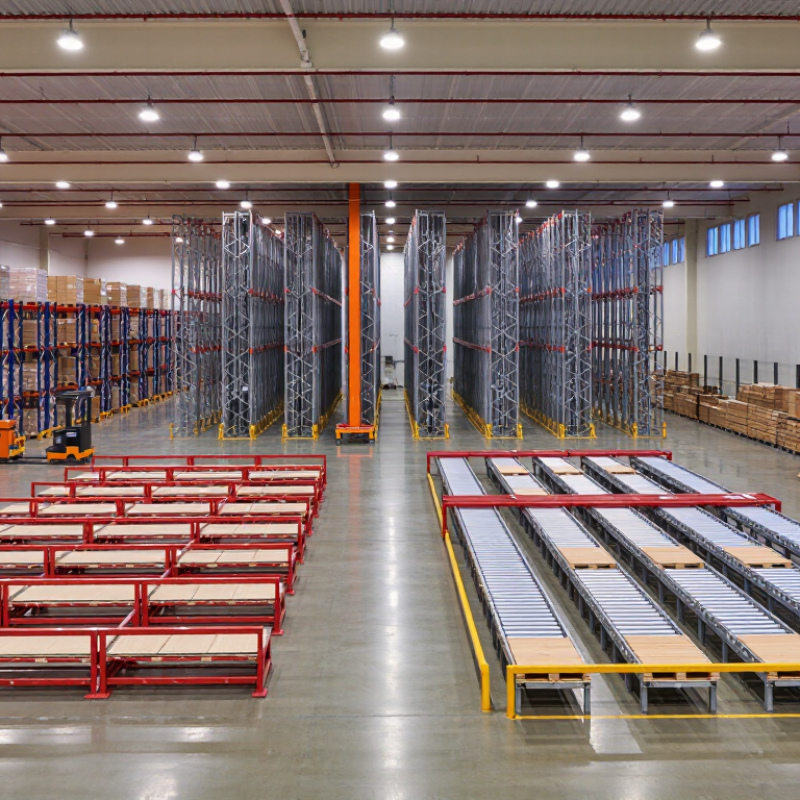
A pallet rack is a steel structure that stores palletized goods above the floor and keeps loads accessible for handling equipment. A common selective-rack bay has two upright frames joined by horizontal beams. Each beam pair supports a pallet level; the frames transfer the load to the floor.
Simple, but not casual.
Upright frames contain vertical columns and diagonal or horizontal bracing. Beams connect the frames and usually lock into their columns with connectors. Base plates spread forces at floor level, while anchors help secure the frame. Wire decking, row spacers, and column guards may also be fitted, depending on the layout and hazards.
Small parts matter. A bent connector or unseated beam can change how the structure carries a load.
The Rack Manufacturers Institute’s ANSI MH16.1 specification addresses the design, testing, and use of steel storage racks. MHI’s 2024 Annual Industry Report found that 55% of surveyed supply-chain professionals planned to increase technology investment. That shift makes clear rack dimensions and load information especially useful when planning around automation.
Still, a capacity label is not the whole story: beam span, pallet weight distribution, installation, and damage all affect safe use. A label can be easy to misread. Check the rack’s configuration and condition, not just its stated capacity.

What Are the Top Types of Pallet Rack?
How Do Selective Racks Provide Direct Access to Every Pallet?
Common pallet rack types include selective, drive-in, push-back, and pallet-flow systems. Selective racks store pallets in individual positions, with an aisle facing each row. A forklift can reach a chosen pallet without moving neighboring loads. That direct access suits warehouses handling many product types or frequent order changes. Pallet labels and load faces are easy to see. No reshuffling.
The trade-off is aisle space. Selective racks often hold fewer pallets per square foot than deeper-lane systems. Forklift turning radius, pallet dimensions, beam capacity, and traffic patterns all affect the layout. A plan may look efficient on paper but feel cramped once long loads and busy shifts are involved. Measure real loads and operating clearances. Selective racks do not guarantee FIFO; staff and inventory controls must manage stock rotation. That detail is easy to overlook.
Tips: Place fast-moving pallets near picking zones, label levels clearly, and keep loads within beam limits. Check frames, beams, and connectors regularly, especially after an impact. If an upright is damaged, do not assume it is harmless; have the affected bay assessed by a qualified professional.
Drive-in and drive-through pallet racks increase storage density by replacing many forklift aisles with deep storage lanes. A forklift enters a lane and places pallets on support rails, often storing several loads behind one another. Fewer aisles mean more floor space can hold inventory. It is a practical trade-off.
Drive-in racks usually have one access point, so the last pallet stored is often the first removed. This suits products handled in larger batches, where strict rotation is less important. Drive-through racks open at both ends and can support first-in, first-out handling when receiving and picking are coordinated. That can help with dated stock, but it needs disciplined lane management.
The details matter. Pallet dimensions, load weight, rack height, and forklift turning clearance all affect how safely a lane works. Deep lanes can also hide available stock or leave a partly empty lane that is difficult to use efficiently. Operators should follow the rack’s load limits and inspect rails and uprights for damage. Density is not free. A layout that looks efficient on paper may slow picking or complicate stock rotation in daily use.
How Do Push-Back and Pallet Flow Racks Move Inventory?
Push-back racks use nested carts on inclined rails. A forklift places each pallet at the front; the next pallet pushes it deeper into the lane. During picking, the remaining pallets roll forward. This creates last-in, first-out access, which suits products that do not require strict age-based rotation. It also stores several pallets per lane. A practical caution: deeper lanes reduce aisle demand, but can make individual pallets less accessible.
Pallet flow racks use gravity rollers instead. Workers load pallets from the rear, and each pallet moves toward the front picking face as space opens. This supports first-in, first-out rotation, useful for dated goods or consistent lot sequencing. Pallet condition matters; damaged boards or uneven loads can interrupt movement. MHI and Deloitte’s 2024 Annual Industry Report found that 55% of surveyed supply-chain leaders planned to increase technology investment. That figure reflects wider industry interest, not proof that either rack type fits every operation. Measure pallet dimensions, load weights, throughput, and replenishment space before choosing. Small details matter. A trial lane can reveal problems that a layout drawing misses.
| Rack type | How inventory moves | Pallet access and rotation | Storage density | Common fit and considerations |
|---|---|---|---|---|
| Selective pallet rack | Forklifts place and retrieve pallets directly from each rack position. | Direct access to each pallet; supports flexible rotation and picking. | Lower than deep-lane systems because aisles are needed between rack rows. | Useful for many SKUs, varied product turnover, and operations that prioritize selectivity. |
| Double-deep rack | Pallets are stored two positions deep; a suitable deep-reach truck retrieves the rear pallet. | Front pallets can restrict access to rear pallets, so access is less direct than in selective rack. | Higher than single-deep selective rack, with fewer aisles per stored pallet position. | Can suit operations holding multiple pallets per SKU; requires compatible handling equipment and inventory planning. |
| Drive-in / drive-through rack | A forklift enters a lane and places pallets on support rails. Drive-in typically loads and unloads from the same end; drive-through allows access from opposite ends. | Pallets within a lane are less individually accessible. Drive-in commonly operates LIFO; drive-through can support FIFO when loading and unloading are separated. | High, because fewer aisles are needed and pallets are stored several positions deep. | Often suited to larger quantities of fewer SKUs. Forklift travel inside lanes calls for careful operating procedures. |
| Push-back rack | A newly loaded pallet pushes the pallets already in the lane backward on nested carts along slightly inclined rails. When a pallet is removed, the next pallet moves forward by gravity. | Typically loaded and unloaded from the same aisle, so each lane generally follows LIFO: the last pallet loaded is the first retrieved. | High; multiple pallets can be stored deep without driving a forklift into the lane. | Can suit multiple pallets per SKU where compact storage and faster access than drive-in are priorities. Lane depth and pallet compatibility need to be planned. |
| Pallet flow rack | Pallets are loaded at the higher rear end and travel by gravity on roller or wheel tracks toward the lower picking face as front pallets are removed. | Usually loaded from one side and picked from the other, supporting FIFO: the first pallet loaded is the first available for retrieval. | High; deep lanes reduce aisle requirements while keeping replenishment and picking faces separate. | Can suit date-sensitive or regularly rotated stock. Pallet condition, load characteristics, lane design, and flow controls affect performance. |
| Pallet shuttle rack | A powered shuttle carries pallets along rails within a lane; forklifts place and retrieve pallets at the lane entrance. | Access is generally lane-based rather than pallet-by-pallet. Depending on the operating method, systems can be configured for LIFO or FIFO. | High, with deep storage lanes and reduced forklift travel inside the rack. | Can suit high-volume, repetitive storage. Requires powered equipment, controls, and a plan for shuttle charging and maintenance. |
FIFO means first in, first out; LIFO means last in, first out. Actual capacity, lane depth, and equipment requirements depend on the rack design, pallet loads, building layout, and applicable safety requirements.
Cantilever racks are designed for long, awkward loads such as timber, pipe, and metal sections. Their open fronts make loading easier with a forklift, while adjustable arms support different lengths. The arms need proper spacing; a bundle resting on only a few points can bend or shift. Keep heavier stock on lower levels, and check each bay’s rated capacity before loading.
A rack-supported mezzanine adds a usable floor above existing storage, creating room for light assembly, picking, or cartons. It can help when floor space is tight. But it also changes how people and goods move through the building. Stairways, guardrails, gates, lighting, and floor loading all need careful planning. Measurements on paper may miss a low beam or a busy aisle. That happens.
Tips: Measure the longest load, including any overhang, and confirm forklift turning clearance. For a mezzanine, verify the building floor’s capacity and have the structure reviewed by a qualified professional. Keep load signs visible. Small details matter.
Cantilever racks are commonly used for long, bulky items such as lumber and pipe. Mezzanines create an additional floor level. Drive-in, push-back, pallet-flow, and double-deep racks are primarily used to increase pallet storage density. A value of 1 marks a common primary application; 0 means it is not the system’s defining use, not that the use is technically impossible. This is a general comparison, not an engineering specification.
For an immediate response, please call this
number08045801431
Price:
