
GST : 27AAFFV7667M1ZA

call images

Call us

08045801431

What Is the Longest Range Walkie Talkie?

What Is the Longest Range Walkie Talkie? The answer depends less on a bold number printed on a box and more on where you use the radio. Open ground, clear line of sight, a well-positioned antenna, and suitable power can all improve communication. Hills, buildings, trees, and even a radio kept inside a bag can reduce the useful range. Small details matter.

Some models advertise communication over dozens of miles, but that figure usually reflects ideal test conditions. Real use can feel very different. On a wooded trail, two users may lose contact much sooner than expected; across open water or flat land, the same radios may perform better. There is no single model that guarantees the greatest range in every setting. That is the honest, slightly inconvenient part.

This guide explains what “longest range” really means and how to compare walkie-talkies more carefully. It looks at radio type, antenna design, battery performance, terrain, and stated range claims. It also distinguishes advertised distance from dependable, everyday coverage. Choose equipment approved for your location, and check applicable radio-use requirements before transmitting. A powerful radio is not automatically the right one. The best choice is the model that maintains clear contact in your actual environment, with enough battery life and simple controls for the people using it. Expect trade-offs, and test the radios before relying on them.
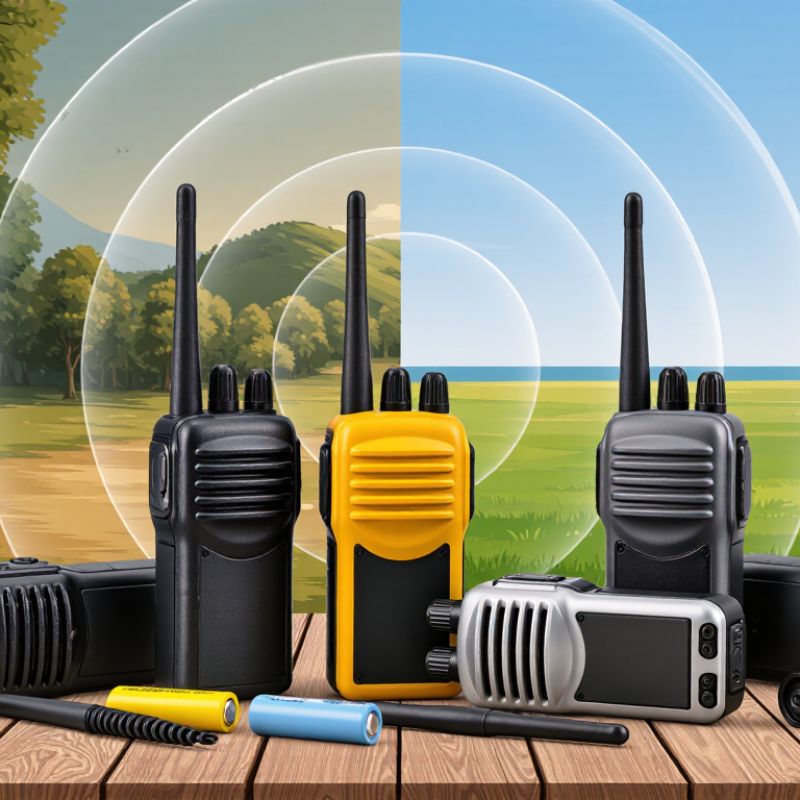
What Is the Longest Range Walkie Talkie?

What “Longest Range” Means for Walkie-Talkies

“Longest range” is not a fixed distance printed on a radio. It is a best-case estimate, often measured across open ground with clear line of sight. A hill, concrete wall, or row of buildings can shorten the link dramatically. ITU-R Recommendation P.1812 models terrestrial radio paths from 30 MHz to 6 GHz and accounts for terrain and land cover. That technical detail matters: two radios with identical power can perform very differently when one path crosses a ridge. Not a promise.

Power figures need context, too. In the United States, FCC rules allow up to 2 watts effective radiated power on certain Family Radio Service channels; other channels have lower limits (47 CFR §95.567). That figure describes permitted output, not a guaranteed operating radius. Antenna position, battery condition, interference, and even where a person holds the radio affect reception. A test across a quiet field can make a model look impressive. A busy street is less forgiving. It is tempting to compare only advertised miles, but those numbers rarely describe your route. Check the terrain, intended use, and applicable local rules before treating a range claim as practical.

How Radio Frequency and Terrain Affect Communication Range

What Is the Longest Range Walkie Talkie?
How Radio Frequency and Terrain Affect Communication Range

Walkie-talkie range is not a fixed number printed on a box. It depends on frequency, antenna design, transmit power, and the path between radios. Higher frequencies can provide clear audio over open routes, but buildings and dense vegetation may weaken the signal. Lower frequencies may bend around some obstacles more effectively, though hills and heavy structures still block communication. Line of sight matters.

Two handheld radios might connect across several miles of flat, open ground, then lose contact behind a ridge or inside a concrete building. Trees absorb and scatter radio energy. Metal walls can reflect signals, creating dead spots only a few steps apart. Elevation helps: a radio on a hill can reach farther than one near a valley floor. Small changes matter.

Advertised range figures usually reflect favorable conditions, not a crowded trail or a route between apartment blocks. Keep the antenna upright, move away from large metal objects, and test from the places where you plan to communicate. A higher, clearer position may help more than a larger number on the package. Even careful estimates can be wrong.

Which Walkie-Talkie Types Offer the Greatest Practical Range

The longest practical range usually comes from a radio with a clear path, an elevated antenna, and access to a compatible repeater. A powerful handheld can still struggle between concrete buildings or behind a ridge. ITU-R Recommendation P.1411 describes how terrain, buildings, and frequency affect short-range outdoor radio propagation. In practice, a park can feel effortless; a basement can feel like a different world.

Among handheld types, higher-power models generally have an advantage over basic, low-power units, but power alone cannot promise distance. For example, FCC rules cap Family Radio Service output at 2 watts on some channels and 0.5 watts on others (47 CFR §95.567). Those are technical limits, not guaranteed coverage figures. Vehicle-mounted radios with properly installed antennas, or repeater-capable systems used where authorized, often offer greater practical reach. Local rules differ, so check the requirements where you operate. Even a careful range estimate can be wrong once buildings, weather, and antenna placement enter the picture.

Tips: Test radios along your actual route, not just in an open field. Hold the antenna upright, move away from metal walls, and try a higher spot. A short test can reveal more than a headline range claim.

What Is the Longest-Range Walkie-Talkie?

Typical practical range in direct, line-of-sight use

GMRS and licensed amateur handheld radios can often reach farther than FRS radios in open terrain. These approximate ranges are not guarantees: buildings, hills, antenna height, and local conditions can greatly change results. Repeaters, where permitted and available, can extend communication beyond direct radio-to-radio range.

Legal Power Limits and Range-Extending Features

Legal power limits set a hard ceiling on walkie-talkie range. In the United States, FCC Part 95 rules limit Family Radio Service (FRS) radios to 2 watts ERP on channels 1–7 and 15–22, and 0.5 watts ERP on channels 8–14 (47 CFR §§ 95.563, 95.567). Other countries set different limits. A maker’s advertised range is not a dependable field guarantee; hills, walls, and interference can shrink it sharply. Terrain matters.

Range-extending features work within the rules. A clear, elevated position can improve line of sight, while a well-matched antenna can help on services that legally allow one. Licensed services may also permit repeaters, which relay signals across a wider area. The ITU-R P.1812 propagation method evaluates terrain and building effects when estimating terrestrial radio coverage. That is a useful reminder: power alone cannot predict a real route. I would still test the route itself; a map can miss a concrete stairwell or a deep valley.

Tips: Test outdoors before relying on a radio. Keep the antenna upright, move away from metal walls, and compare reception from higher ground. Check local rules before changing antennas or using repeaters.

How to Compare Range Claims and Choose a Suitable Model

What Is the Longest Range Walkie Talkie?

How to Compare Range Claims and Choose a Suitable Model

A claimed maximum range is not a dependable prediction for daily use. It usually reflects favorable conditions, such as clear line of sight and little interference. Trees, hills, walls, and a radio held near the ground can shorten the usable link. Not a field guarantee. Compare models by asking how their range was measured, and whether the test resembles your route, building, or worksite.

ITU-R Recommendation P.525-4, Calculation of Free-Space Attenuation (2019), provides a useful reference point. Its free-space formula gives about 86 dB of path loss over one kilometre at 462 MHz, and about 100 dB over five kilometres. That roughly 14 dB increase shows why extra distance quickly challenges a radio link. Real terrain adds complications the formula does not capture.

Small details matter. Check receiver sensitivity, antenna design, battery condition, and whether the radio maintains clear audio at the far end.

For a practical comparison, test candidate models on the same route, at the same height, and with fresh batteries. Record where speech first becomes unreliable. This is an imperfect test; weather, people, and nearby structures can change results. Still, it is more useful than choosing by the largest number on a package.

Back to top
