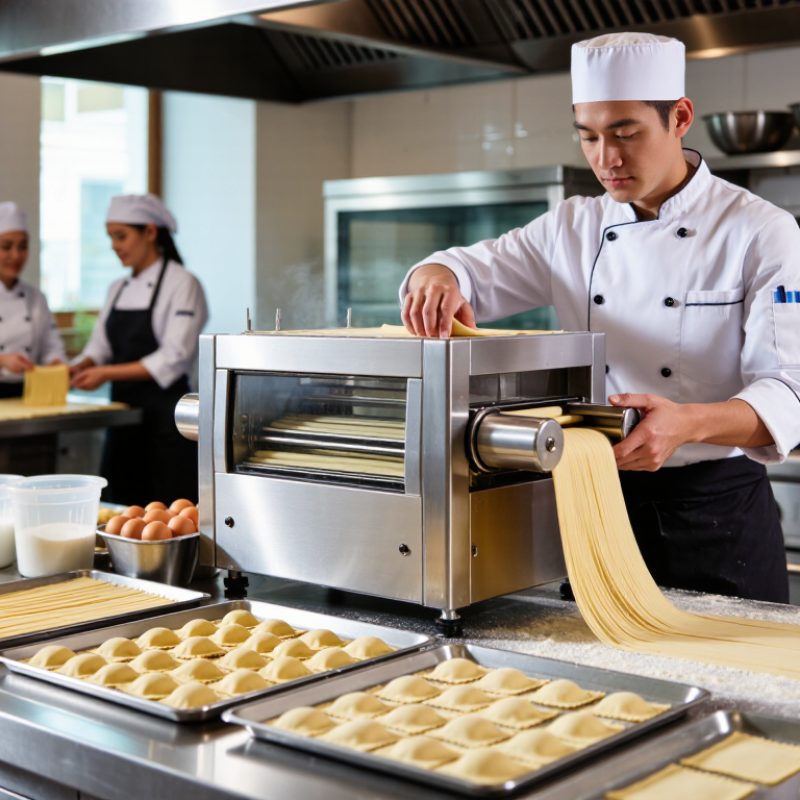
Choosing the right Pasta And Noodle Maker can shape a food business from the kitchen upward. It affects production speed, product consistency, labor costs, and customer satisfaction. A reliable machine can turn measured flour, water, and eggs into uniform dough. That consistency matters when serving hundreds of portions each day.
In a busy restaurant, staff may prepare dough before opening. The machine can mix, knead, and form pasta with less manual effort. Some models support different cutters, noodle widths, and production capacities. This flexibility helps businesses serve fresh spaghetti, noodles, ravioli, or specialty shapes. It also reduces dependence on individual workers’ hand skills. However, equipment alone cannot fix poor recipes or weak workflow. Careful testing remains essential.
Business owners should examine motor power, food-contact materials, cleaning access, safety features, warranty coverage, and supplier support. A stainless-steel frame may withstand daily use, but only with proper maintenance. Easy disassembly can save valuable cleaning time between batches. Operators should also compare output claims with real production conditions. Flour humidity, dough hydration, and staff experience can change results. The most expensive model is not always the best choice. A smaller machine may suit a growing café better. That decision deserves honest review. With practical training, documented procedures, and regular inspections, a Pasta And Noodle Maker can become a dependable production partner rather than another costly appliance.
Business needs shape the role of pasta and noodle makers. Grand View Research valued the global pasta market at about USD 68.35 billion in 2023. It also forecasts continued growth through 2030. This expansion reflects demand for convenient, affordable, and customizable meals. Small restaurants and food manufacturers must respond quickly. A reliable maker can produce consistent dough sheets, strands, or filled shapes during busy service.
Consistency matters more than appearance alone. A commercial machine helps control dough thickness, cutting size, and portion weight. That can reduce uneven cooking and unnecessary waste. In a working kitchen, a staff member can prepare dough while another loads trays or manages sauces. The benefit is practical. Less manual rolling also supports safer, more organized production. Fortune Business Insights reports that the global noodles market was worth approximately USD 53.85 billion in 2023, showing strong demand across retail and foodservice channels.
However, buying a maker is not automatically profitable. Capacity must match real orders, not optimistic forecasts. A machine designed for high output may waste space, electricity, and labor in a small kitchen. Cleaning time also matters. A poorly planned workflow can turn useful equipment into a bottleneck. Business owners should compare output per hour, changeover time, maintenance access, and staff training needs. Reports provide market direction, but they cannot replace local testing. A short trial with actual flour, recipes, and peak-hour orders may reveal uncomfortable gaps. That reflection is valuable.

Commercial pasta and noodle equipment is built for steady production, not occasional home cooking. The key feature is controlled dough handling. A strong mixer should combine flour and water evenly without overheating the dough. Adjustable rollers can set thickness for sheets, ribbons, or dumpling wrappers. Extrusion systems should maintain stable pressure, so each strand keeps a similar shape. Consistency matters.
Look for food-grade stainless steel surfaces and removable contact parts. These details make cleaning faster between batches. Smooth corners reduce trapped flour and moisture. Safety guards and automatic shutoffs protect operators near cutters and moving rollers. Digital controls can store useful settings, but simple manual adjustments still help when flour moisture changes. That happens often.
Capacity must match the kitchen’s actual workload. A large machine is not always the better choice. Oversized equipment may waste energy and require more cleaning time. In a busy operation, reliable output, quick changeovers, and accessible maintenance points often matter more than maximum speed. Some machines leave dough scraps near the cutter, which needs regular inspection. No machine fixes poor dough. Operators still need to monitor hydration, resting time, and noodle texture. A short trial with local recipes can reveal problems before full production begins.
| Evaluation Dimension | Commercial Pasta Equipment | Commercial Noodle Equipment | Business Value |
|---|---|---|---|
| Primary Product Forms | Spaghetti, macaroni, penne, fusilli, lasagna sheets and filled pasta, depending on the die or forming system. | Ramen-style, chow mein, udon, soba, egg noodles and other cut or extruded noodle formats. | Supports menu variety and allows one production area to serve multiple product categories. |
| Typical Production Capacity | Approximately 20–100 kg of finished product per hour for compact and medium commercial machines; larger lines can exceed this range. | Approximately 30–150 kg per hour for compact and medium commercial systems, depending on dough condition and noodle size. | Provides a scalable output level for restaurants, catering operations, specialty food shops and small factories. |
| Main Forming Method | Extrusion through interchangeable dies, sheet rolling, cutting or a combination of these processes. | Roller sheeting followed by slitting, or extrusion through a shaped die for selected noodle varieties. | Improves shape consistency and reduces dependence on manual forming skills. |
| Dough or Mixing System | Many commercial units combine mixing and forming; some require a separate mixer for greater batch control. | Often paired with a dough mixer, resting section and roller system to develop the required elasticity and texture. | Helps standardize flour, water and ingredient distribution from batch to batch. |
| Adjustable Product Thickness | Sheet rollers commonly offer adjustable thickness; settings vary by machine design and product type. | Roller gaps and cutter settings can usually be adjusted for thin, medium or thick noodles. | Makes it easier to meet different cooking times, textures and recipe specifications. |
| Changeover Flexibility | Interchangeable dies and cutters can support several shapes; changeover time depends on the design and cleaning requirements. | Interchangeable slitting rollers or cutting tools can produce different widths and strand profiles. | Enables customized products without purchasing a separate machine for every format. |
| Power Requirement | Compact commercial models commonly use about 1.5–5.5 kW; larger integrated lines may require more power. | Compact and medium systems commonly use about 2.2–7.5 kW, depending on roller count, extruder size and automation level. | Allows operators to compare electrical infrastructure and operating costs before purchase. |
| Food-Contact Materials | Food-contact areas are commonly made from stainless steel or other approved food-contact materials. | Food-contact rollers, cutters and hoppers are commonly manufactured from stainless steel or approved food-grade materials. | Supports hygiene management, corrosion resistance and easier sanitation when correctly maintained. |
| Automation Level | Options range from manual feeding and adjustment to automatic mixing, extrusion, cutting and portion control. | Options range from manually fed roller units to continuous lines with automated sheeting, cutting and conveying. | Lets a business match labor savings and investment level to its actual production volume. |
| Portion and Size Consistency | Mechanical cutting and calibrated dies help maintain uniform shape and portion size. | Adjustable rollers and cutters help control strand width, thickness and length. | Improves cooking consistency, packaging accuracy and customer experience. |
| Cleaning and Maintenance | Removable dies, cutters and covers simplify cleaning; dry cleaning may be required for components that should not be exposed to water. | Accessible rollers, cutters and dough-contact parts support routine cleaning and inspection. | Shortens sanitation downtime and helps maintain food-safety procedures. |
| Safety Features | Commercial designs may include guarded moving parts, emergency-stop controls, overload protection and interlocked covers. | Common safety provisions include roller guards, emergency-stop controls and protection around cutters or extrusion zones. | Reduces operational risk when equipment is installed, trained and maintained correctly. |
| Best-Fit Business Applications | Restaurants, fresh-pasta counters, hotels, catering kitchens, meal producers and specialty food manufacturers. | Asian restaurants, noodle shops, commissary kitchens, catering operations and packaged-noodle producers. | Offers a practical route to higher output, repeatable quality and lower manual processing requirements. |
Note: Capacity, power consumption and available product formats vary by machine configuration, dough formulation, operating speed and local electrical requirements.
A pasta and noodle maker turns repeated handwork into measured, repeatable production. That matters when dough hydration, sheeting pressure, and cutting speed vary between operators. The International Pasta Organisation reported roughly 17 million tonnes of pasta production worldwide in 2022. At that scale, small variations become expensive. Uneven strands cook differently, while excess trim increases material loss. A machine cannot repair a poor recipe, but it can hold critical settings steady.
Modern equipment combines controlled mixing, calibrated extrusion, and adjustable cutters. Operators can record batch settings, monitor dough temperature, and correct drift before hundreds of kilograms are affected. PMMI’s 2024 automation research identifies labor availability, quality control, and throughput as major automation drivers in packaged food production. The practical gain is not only speed. It is a more predictable shift, with fewer manual transfers and less dependence on one experienced worker.
Consistency also supports purchasing decisions and customer trust. A restaurant buyer expects similar diameter, bite, and cooking time each week. Standardized output makes these expectations easier to test against internal specifications. Still, automation is not effortless. Dies wear, sensors need calibration, and cleaning may be rushed during peak demand. In practice, an efficient line can still lose time when changeover instructions are unclear. Training, preventive maintenance, and honest tracking of yield, downtime, and defects remain essential.
Before choosing a pasta and noodle maker, define your actual production conditions. The World Instant Noodles Association reported 120.6 billion servings consumed globally in 2023. That figure suggests strong demand, but demand alone cannot justify a purchase. Measure peak-hour orders, product sizes, dough hydration, and available floor space. A machine rated for 100 kilograms per hour may perform differently with whole-wheat dough or frequent recipe changes. Allowing a 15% to 20% capacity buffer is practical, though it can increase idle time.
Flexibility matters. Ask whether the machine handles sheets, strands, filled pasta, or multiple noodle widths. Request a live test using your flour, water, and seasoning formula. Small differences in hydration can affect pressure, texture, and drying time. Grand View Research forecasts continued growth in the global pasta and noodles market through 2030, but forecasts are not guarantees. Local tastes may matter more than global figures. A machine built for one popular shape could become a costly limitation.
Then examine sanitation, energy use, maintenance access, and operator training. Food-contact parts should be removable and easy to inspect. Check documented cleaning procedures and applicable food-safety requirements in your market. Compare total ownership cost, including molds, electricity, spare parts, downtime, and technical support. The cheapest quotation may hide expensive maintenance. I would not rely on brochure capacity alone. A short production trial often reveals uneven cutting, excess waste, or uncomfortable controls. That evidence is more useful than a polished specification sheet.
A pasta and noodle maker becomes valuable when it fits the daily rhythm, not when it simply sits beside other equipment. Assign one trained operator to check flour, water, dough texture, and machine settings before service. Keep measured ingredients in labeled containers near the feeding area. This reduces pauses during busy periods. Record batch size, mixing time, extrusion speed, and output quality in a simple log. These details help staff repeat successful results across different shifts. Still, the first setup may feel slower than expected. That is normal. Staff need time to learn how humidity changes dough.
Build the machine into the production schedule. Prepare dough during quieter hours, then portion fresh noodles for the lunch or dinner rush. Use a clean, stable worktable for shaping and drying. Keep finished portions covered and dated, following local food-safety requirements. Operators should wash hands, clean contact surfaces, and remove leftover dough after each production cycle. A quick inspection of seals, cutting parts, and electrical connections can prevent avoidable downtime. Do not rush cleaning. A small residue can affect the next batch.
Tips: Start with small batches. Compare texture after cooking. Keep one tested recipe as a reference. Train backup staff, too. Review waste every week, because the machine may expose inconsistent measuring or overproduction. Adjust gradually, and write down what changed. Mistakes become useful only when someone records them.
For an immediate response, please call this
number08045801431
Price:
